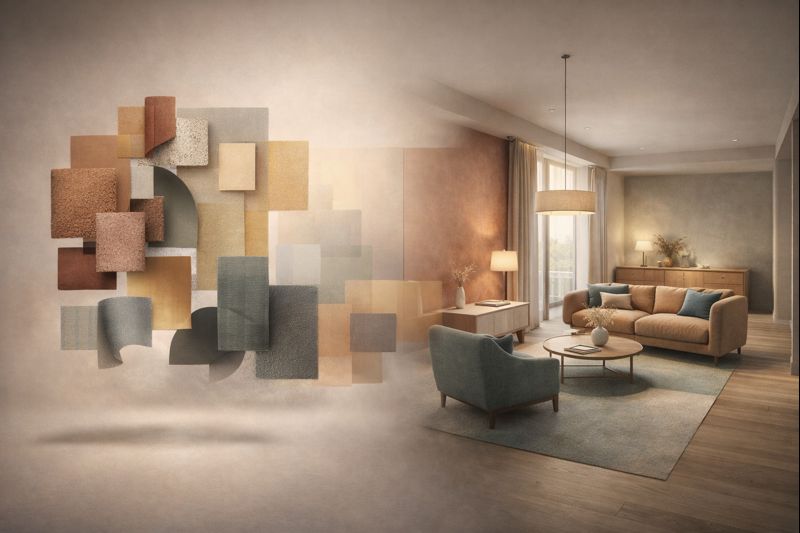
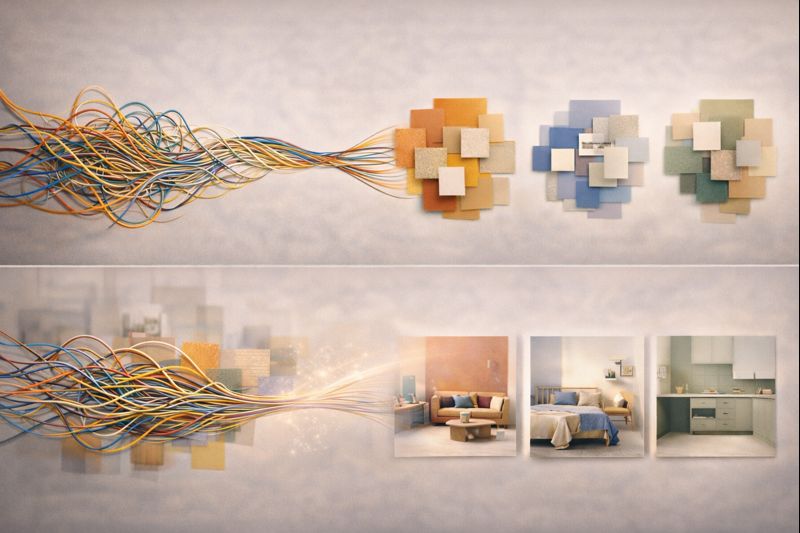
Introduction: The Most Expensive Feedback Comes Too Late
Design projects rarely fail because of bad ideas.
They fail because feedback arrives after commitment.
A client approves a mood board.
The team moves into concept development.
Renders are produced.
Time is spent.
Then the feedback changes.
“I didn’t realize it would feel like this.”
“Can we make it less heavy?”
“This isn’t what I imagined.”
At that point, feedback is no longer helpful—it’s costly.
The real problem is not indecision.
It’s that early feedback is often based on incomplete understanding.
AI mood boards exist to improve the quality of early feedback, not just the speed.
Why Clients Struggle to Give Useful Early Feedback
Clients are asked to make decisions at a moment when they have the least clarity.
Traditional mood boards show fragments:
- materials
- colors
- references
- styles
Clients respond emotionally to these fragments, but they cannot yet imagine:
- how elements combine
- what dominates visually
- how the space might feel at scale
So their feedback stays vague:
- “I like it.”
- “Not sure.”
- “Maybe something else.”
None of this is wrong. It’s just incomplete.
Approval Without Understanding Creates Fragile Decisions
When clients approve a mood board, they often believe they’re approving a direction. In reality, they’re approving a collection of impressions.
Design teams then translate those impressions into spaces, making dozens of interpretive decisions along the way.
When the client finally sees a cohesive design, they react to the interpretation, not the mood board they approved earlier.
That’s when trust feels shaken—even though no one made a mistake.
How AI Mood Boards Change the Nature of Feedback
AI mood boards introduce structure before commitment.
Instead of asking clients to respond to scattered references, designers can present:
- one clear dominant direction
- one or two alternative moods
- visible differences in tone and hierarchy
Clients don’t just react—they compare.
Comparison is powerful because it forces preference to surface. Clients learn what they want by seeing what they don’t.
Feedback becomes:
- more specific
- more confident
- more actionable
And most importantly, it arrives before design effort multiplies.
Early Feedback Becomes Directional, Not Emotional
There’s a subtle but important shift when AI mood boards are used.
Clients stop saying:
“I like this image.”
They start saying:
“I prefer this direction.”
That difference matters.
Liking an image is subjective.
Choosing a direction is intentional.
Directional feedback holds up better when projects evolve, because everyone understands what was actually agreed upon.
Designers Gain Better Questions, Not Just Faster Answers
AI mood boards don’t just improve client responses—they improve designer questions.
Instead of asking:
“Do you like this?”
Designers ask:
“Which direction feels closer to what you want to live/work/experience?”
The conversation moves from taste to intent.
That makes later decisions easier to justify, defend, and refine.
Why Early Clarity Reduces Later Rework
Most redesign happens not because clients change their mind—but because they finally understand the consequences of early choices.
AI mood boards accelerate that understanding.
By presenting cohesive directions early:
- misunderstandings surface sooner
- preferences stabilize
- approvals gain weight
When clarity comes early, later stages feel like progress instead of correction.
And when projects move from inspiration into execution, platforms like Ruwaq Design help carry that clarified intent forward into AEC workflows—so early decisions aren’t lost during coordination and delivery.
Why Clients Feel More Confident Saying “This Is It”
Confidence comes from seeing options clearly.
When clients understand why they prefer one direction over another, they commit more strongly. They’re less likely to reopen decisions later because they remember how they chose—not just what they chose.
That memory matters when projects get complex.
Better Early Feedback Improves Relationships, Not Just Timelines
Design is a relationship business.
When early feedback is clear:
- trust increases
- friction decreases
- revisions feel purposeful
- communication improves
Clients feel heard.
Designers feel respected.
That dynamic is hard to measure—but easy to feel.
Conclusion: Early Feedback Should Be Informed, Not Rushed
The goal of early design feedback is not speed.
It’s quality.
AI mood boards improve early decisions by giving clients enough context to choose direction confidently—before design effort becomes expensive.
When feedback arrives early and clearly, projects move forward with momentum instead of second-guessing.
Design doesn’t need fewer approvals.
It needs better ones, sooner.